Why this exists
One recurring struggle I encountered while ramping my vocabulary in learning Spanish is that when I did not know a word, I would often default to Google Translate to get a definition. That worked some of the time, when the words were basic, but often, for words with dual meanings or connotations that differ from the denotation, there was a severe limitation: the definition I got word-for-word did not make sense in the context I heard it in. Fortunately, large language models have fixed this problem, so that has become a good alternative to Google Translate. Now, over the summer of 2026, I’ve been challenging myself to read denser literature, and in that I’ve been ramping my vocabulary for English as well. And since I’m encountering words that don’t appear in daily life for most people, I thought I needed some type of enhanced system to gain both the definitions and the nuances of how to use the words in context properly, and any potential connotations as well. So this vocabulary solution is both an efficient capture of the words from whatever source I encountered them on my computer, and then a completely robust revision system that is generated at zero cost using local LLMs. And I’m very happy with this, because it’s a truly effective way to learn advanced vocabulary that otherwise would be relatively inaccessible.
What it does
- Turns any word I save while reading in NOOK into a flashcard, no manual export. The word lands in one Anki deck, “NOOK Vocab”, and Anki carries it to my phone.
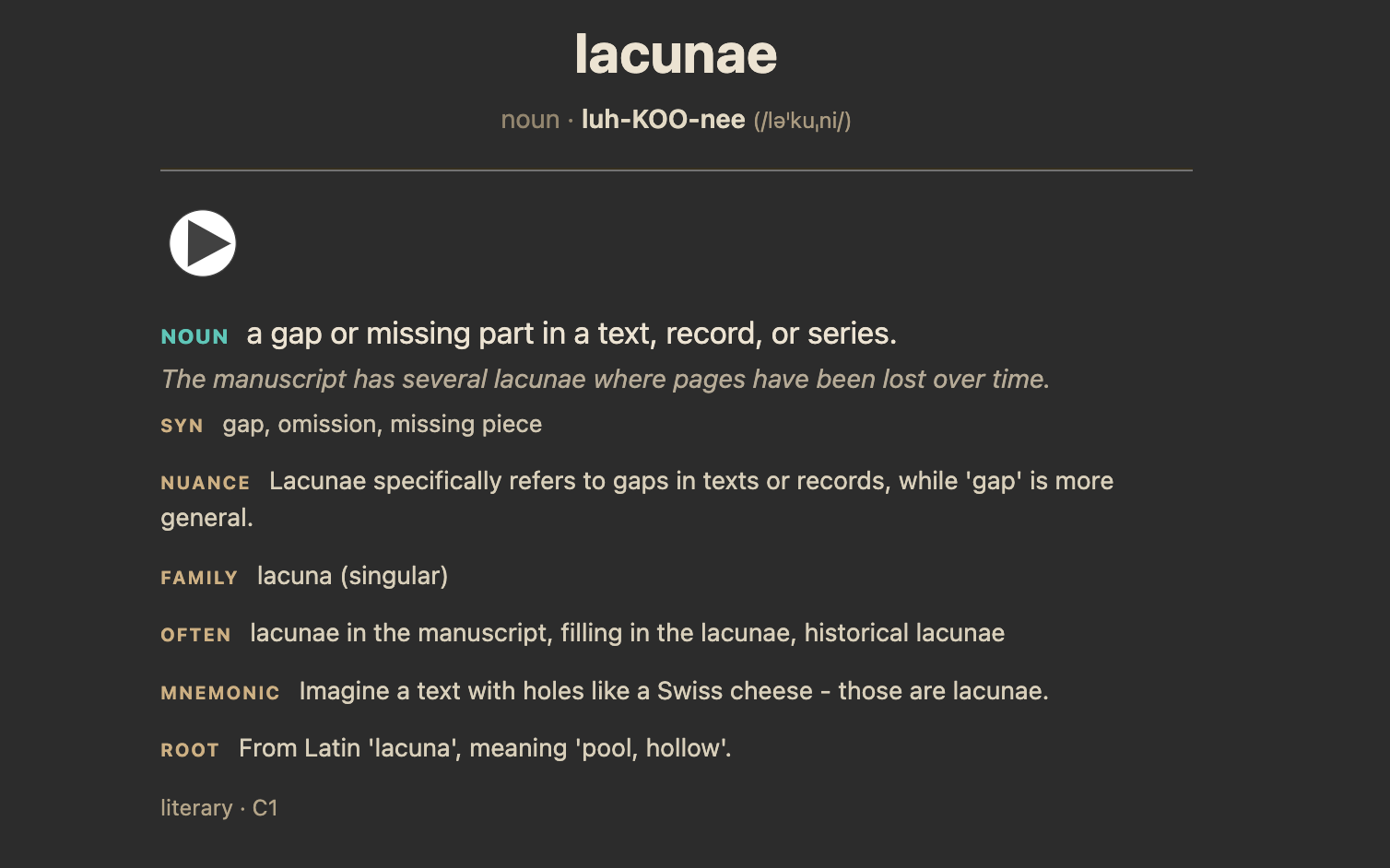
- Enriches each card automatically from a bare dictionary stub into a full entry: senses with per-sense synonyms and antonyms, the nuance that sets the word apart, confusable words, its word family, common collocations, a mnemonic, register and CEFR level, etymology, and a cloze.
- Generates three kinds of card per word: recognition (see the word, recall the meaning), production (a cloze to fill), and discrimination (only when there’s a confusable word worth telling apart).
- Speaks every card in a neural voice for pronunciation, with separate clips for heteronyms like “refuse” so the audio matches the sense.
- Lets me review at my desk in a reviewer built into NOOK, or on my phone through the same deck, graded with real spaced repetition.
- Nudges me twice a day: an 8am push when cards are due, and a 1pm prompt where a local model writes example sentences and hands me a “your turn” challenge.
How it works
- Capture. I save a word in the NOOK reader. It writes to the extension’s own store, which stays the single source of truth for the deck.
- Sync. The extension pushes each new word into Anki through AnkiConnect, into the NOOK Vocab deck, and about a minute later nudges Anki to sync so the card reaches AnkiWeb and my phone on its own.
- Enrich. A local model running under Ollama sweeps the deck every half hour and upgrades each plain card into a custom note type with the three templates and neural-voice audio, under a rule that it flags what it isn’t sure of rather than inventing.
- Review. I grade cards at my desk in a reviewer built into NOOK, or on my phone through the AnkiWeb web app, with the two daily nudges to keep me honest.
A few choices kept it honest. Everything downstream of capture runs locally and free, so there’s no per-word cost and no account. Anki stays the source of truth for scheduling, so I never had to reimplement spaced repetition, only feed it better cards. And the enricher migrates a word in place, so upgrading a card I’ve already studied keeps its review history intact.
What’s next
I feel satisfied with the ontology of this system, so the next steps would just be incremental improvements to make sure that I actually learn and practice the vocabulary. Right now I have it on my phone, on a web app, but it’s not exactly the best UI. So if for some reason this becomes a barrier to usage in the future, perhaps I’ll try to optimize the UI and UX to encourage myself to keep studying, or maybe add some other type of reminders to keep me studying. But generally speaking, I’m happy with the functions of the app, and anything else would be ancillary additions on top of the basic capture-and-define system.
What I learned
This was a powerful demonstration to me of how language models can augment a person’s learning, because the incremental effort here, other than studying the cards, is the same as searching up a definition on Google, if not less. And yet I have very sophisticated cards, generated purely through a system that was fully automated the first time it was made. And even that first time was with the help of AI. So this was a lesson to me that you can really over-engineer things and get remarkable builds: before AI’s evolution over the past year, this would have been a ridiculously overbuilt initiative, but now it’s completely reasonable to do, and it can make little projects become much more interesting.
Status
Shipped, and running daily. Words flow from the reader into Anki, get enriched within the half hour, and turn up on my phone. These days I’m mostly just studying the cards.